The Freedom V is a great tool and principle because it helps you see the link between freedom and self-governance. The V graphic is self-explanatory. The table to the right in the picture below provides more information.
The two essential elements are the V shape and the arrow in the middle.
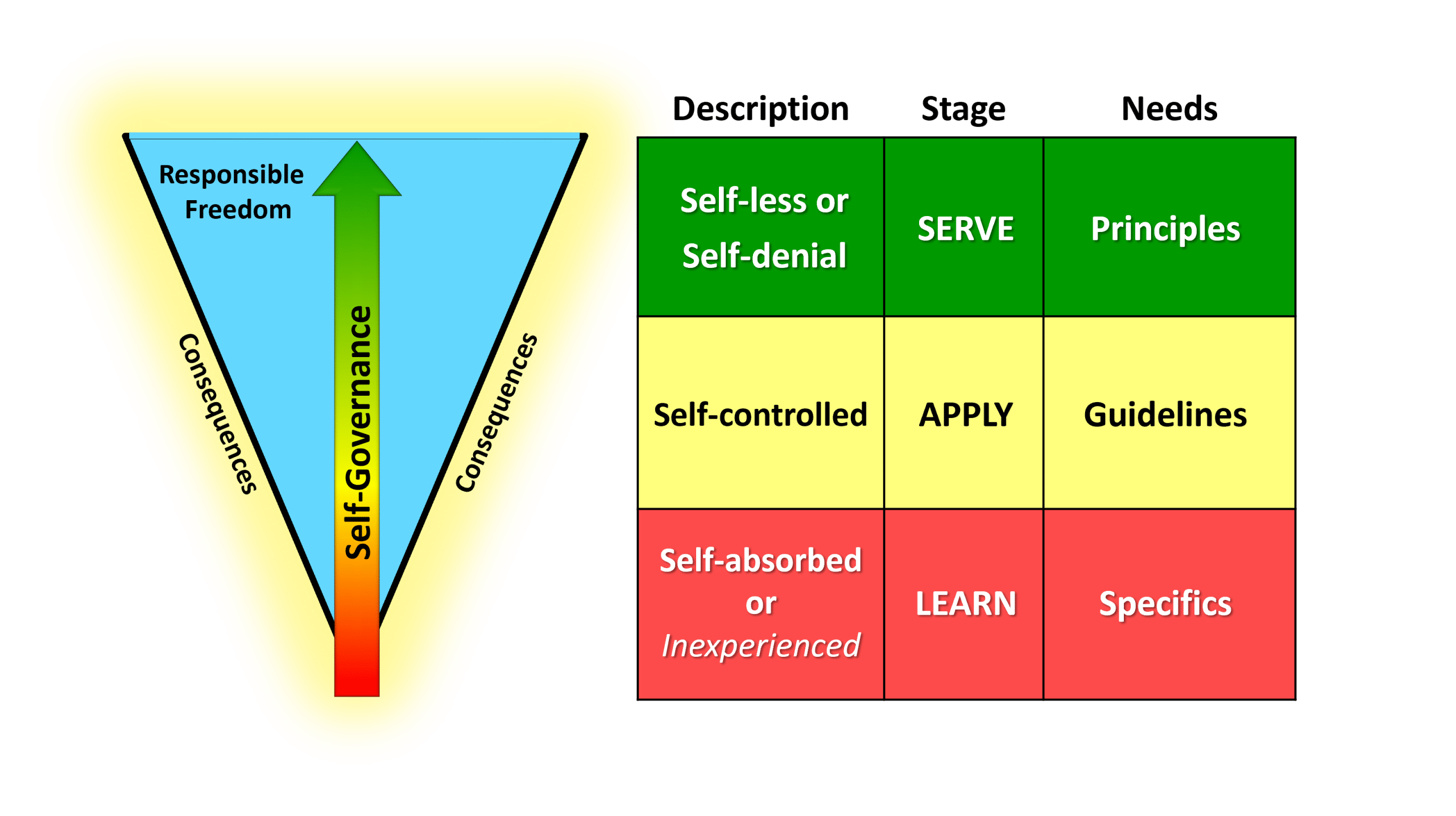
Freedom V Graphic
First, the V shape. The lines on the right and left are boundaries that define the limits of acceptable behavior. So, make sure the boundaries are clear and bright. That means you do not leave anything for speculation or conjecture. And make sure the boundaries are easily known and advertised.
Second, the space inside the V represents the area of Responsible Freedom. That is where you use freedom correctly or within the structure's accepted norms. As you can see, the amount of freedom increases as you move up the V shape. The structure can be either malevolent or benign, but there will still be a V shape. Even in the most disgusting dictatorships or gangs, there are those who gain more freedom when they do not cross the boundaries set by the structure.
Third, outside the V, there are consequences for crossing the boundaries. Once you cross the boundary, you move into the area of Irresponsible Freedom. Again, this applies to both good and bad value organizations or structures. Even evil organizations have their boundaries. Take the time to state the consequences clearly when the boundaries are set.
Finally, the arrow in the middle represents self-governance. The color on the arrow represents the degree of self-governance a person demonstrates. At the bottom, it is inadequate. The yellow and green represent the increase in self-governance as you move from bottom to top. They directly correlate with the narrow or expansive freedom shown.
Three Levels
So, when we abide by the rules of the structure and stay inside the boundaries, greater responsible freedom is available. In other words, the more you demonstrate self-governance, the more freedom is available.
In the graph above, the table to the right provides additional ways to look at the Freedom V. For example, you can divide self-governance into three distinct levels that can overlap.
- Self-absorbed – From the bottom in the red into the yellow area on the self-governance arrow. That would be someone who is either inexperienced, without knowledge about a topic, or ignores what is right. That is the Learning Stage. In that stage, people need specific rules because there are tighter controls. That does not mean ignoring the "why" of the rules.
- Self-controlled – From the middle yellow area into the green. That would be someone who is exhibiting an adequate level of self-governance. This can be measured generally or specifically for individual work or life situations. They are in the Apply Stage, where they mostly need guidelines since they understand the rules.
- Selfless or Self-denial – The top area of self-governance that tends to work to benefit others. That is the Serve Stage, where people operate based on principles and know how to apply those principles to various life situations broadly.
The Freedom V will work with any structure and is especially good for families and organizations with great values.
An Example - Using It With Children
A person with self-governance considers others and their actions impact on others. They stay within the V as long as the freedom inside the V is about good values.
Tight Boundaries at First
Suppose you are responsible for a baby and you are a wise parent. You create tight boundaries for them because they need to gain knowledge or experience with how things work. You put them in controlled environments like a crib or playpen, watch them, and help them reduce significant harm. At the same time, you provide them enough freedom to see if they can learn how to stay within the boundaries.
Expanding Boundaries
You still have relatively tight boundaries when the baby has grown into a toddler. They will be learning to stay within the boundaries for the freedom you give them and experiencing the consequences when they don’t. The rules and expectations you create for them are an invitation to live wisely, not a way to ensure that they know you are the one in charge. You invite them to live by rules because it helps them escape the consequences. If you see them moving toward a boundary, you may warn them, but allow them to choose if the consequences aren’t too severe.
Expansive Boundaries
When a child grows older, the boundaries expand as they show the ability to make the right choices. Since you have taught them how to recognize boundaries for themselves, they hopefully make good choices while they are away at school, with friends, or by themselves. The more they show self-governance, you provide greater freedom. When they cross the boundaries, you reduce their freedom by moving them down the V.
You might tell an older child, “Go where you want, be safe, and be home by sunset.” If that does not happen, and you determine it is willful disobedience, move them down the freedom V until they demonstrate they will likely be home at the designated time.
Reason for the Boundaries
The goal is to have the child set boundaries that are always inside the precise boundaries you have outlined.
If you remember, the definition of self-governance is “delaying immediate gratification for future benefit.” Another simple, very practical way to see self-governance is when you, rather than the authorities, set boundaries for yourself.
You value people when you commit to influencing people to be self-governing. You cannot do it for them. As much as you might want to control, it is often best to allow people to cross the boundary and suffer the consequences, if not too severe for them or the organization. You can control the people you lead, but it is seldom the best action. Exercising personal freedom is an essential part of what it means to be human and learning how to be self-governing after experiencing consequences.
If you learn to pre-decide, then you become more self-governing and suffer fewer consequences.